Vue3 vs Vue2
vue3
ref用于定义基本类型和引用类型,reactive仅用于定义引用类型
reactive只能用于定义引用数据类型的原因在于内部是通过ES6的Proxy实现响应式的,而Proxy不适用于基本数据类型
ref定义对象时,底层会通过reactive转换成具有深层次的响应式对象,所以ref本质上是reactive的再封装
ref
1
2
3
4
5
6
7
8
9
10
11
12
13
14
15
16
17
18
19
20
21
22
23
24
25
26
27
28
29
30
31
32
33
34
35
36
37
38
|
class RefImpl<T> {
public dep: Dep
private _value
public _rawValue
public __V_IS_REF: boolean = true
constructor(value: T) {
this._rawValue = value
this._value = convert(value)
this.dep = new Set()
}
get value() {
trackRefValue(this)
return this._value
}
set value(newValue) {
if (!hasChanged(newValue, this._rawValue)) return
this._value = convert(newValue)
this._rawValue = newValue
triggerEffects(this.dep)
}
}
export function ref<T>(value: T) {
return new RefImpl(value)
}
|
Vue3 vs Vue2
优势
组合式API:
- 更好的逻辑复用
- 更灵活的代码组织
- 更好的类型推导
- 更小的生产包体积
组合式API
1
2
3
4
5
6
7
8
9
10
11
12
13
14
15
16
17
18
19
20
| <script setup>
import { ref, onMounted } from 'vue'
const count = ref(0)
function increment() {
count.value++
}
onMounted(() => {
console.log(`计数器初始值为 ${count.value}。`)
})
</script>
<template>
<button @click="increment">点击了:{{ count }} 次</button>
</template>
|
全局API
1
2
3
4
| import { createApp } from 'vue'
const app = createApp({})
|
| 2.x 全局 API | 3.x 实例 API (app) |
|---|
| Vue.config | app.config |
| Vue.config.productionTip | 移除 (见下方) |
| Vue.config.ignoredElements | app.config.compilerOptions.isCustomElement (见下方) |
| Vue.component | app.component |
| Vue.directive | app.directive |
| Vue.mixin | app.mixin |
| Vue.use | app.use (见下方) |
| Vue.prototype | app.config.globalProperties (见下方) |
| Vue.extend | 移除 (见下方) |
Treeshaking
1
2
3
4
5
6
| import { nextTick } from 'vue'
nextTick(() => {
// 一些和 DOM 有关的东西
})
|
v-model 和 sync
1
2
3
4
5
6
7
8
9
10
11
12
13
14
| // vue2
<ChildComponent v-model="pageTitle" />
<ChildComponent :value="pageTitle" @input="pageTitle = $event" />
<ChildComponent :title="pageTitle" @update:title="pageTitle = $event" />
<ChildComponent :title.sync="pageTitle" />
// vue3
<ChildComponent v-model="pageTitle" />
<ChildComponent :modelValue="pageTitle" @update:modelValue="pageTitle = $event"
/>
|
key
1
2
3
4
5
6
7
8
9
10
11
|
<template v-for="item in list">
<div :key="'heading-' + item.id">...</div>
<span :key="'content-' + item.id">...</span>
</template>
<template v-for="item in list" :key="item.id">
<div>...</div>
<span>...</span>
</template>
|
v-if,v-for
2.x 版本中在一个元素上同时使用 v-if 和 v-for 时,v-for 会优先作用。
3.x 版本中 v-if 总是优先于 v-for 生效。
响应式原理
Vue 2 使用 getter / setters 完全是出于支持旧版本浏览器的限制。而在 Vue 3 中则使用了 Proxy 来创建响应式对象,仅将 getter / setter 用于 ref。
1
2
3
4
5
6
7
8
9
10
11
12
13
14
15
16
17
18
19
20
21
22
23
24
25
26
| function reactive(obj) {
return new Proxy(obj, {
get(target, key) {
track(target, key)
return target[key]
},
set(target, key, value) {
target[key] = value
trigger(target, key)
}
})
}
function ref(value) {
const refObject = {
get value() {
track(refObject, 'value')
return value
},
set value(newValue) {
value = newValue
trigger(refObject, 'value')
}
}
return refObject
}
|
track收集依赖,trigger触发更新
vue2
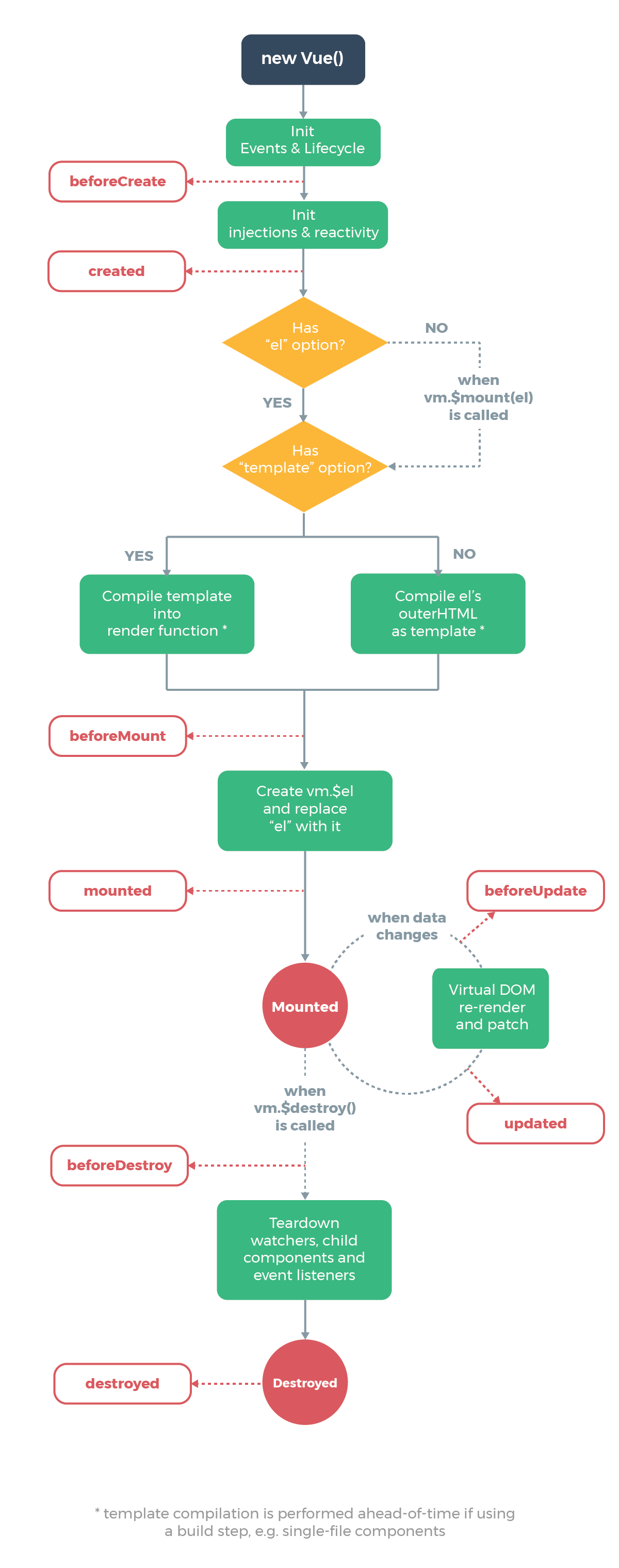
生命周期
在Vue中,父子组件的生命周期执行顺序遵循以下规则:
- 父组件 beforeCreate
- 父组件 created
- 父组件 beforeMount
- 子组件 beforeCreate
- 子组件 created
- 子组件 beforeMount
- 子组件 mounted
- 父组件 mounted
更新过程中:
- 父组件 beforeUpdate
- 子组件 beforeUpdate
- 子组件 updated
- 父组件 updated
销毁过程中:
- 父组件 beforeDestroy
- 子组件 beforeDestroy
- 子组件 destroyed
- 父组件 destroyed
![Vue 实例生命周期]()
provide/inject
1
2
3
4
5
6
7
8
9
10
11
12
13
14
15
16
17
18
19
20
21
22
23
24
25
26
27
28
|
provide() {
return {
getBeCascaded: () => this.beCascaded
};
},
inject: ['beCascaded']
computed: {
beCascaded() {
return this.beCascaded();
}
}
this.beCascaded
provide() {
return {
obj: {
beCascaded: this.beCascaded
}
};
}
inject: ['obj']
this.obj.beCascaded
|